Overview
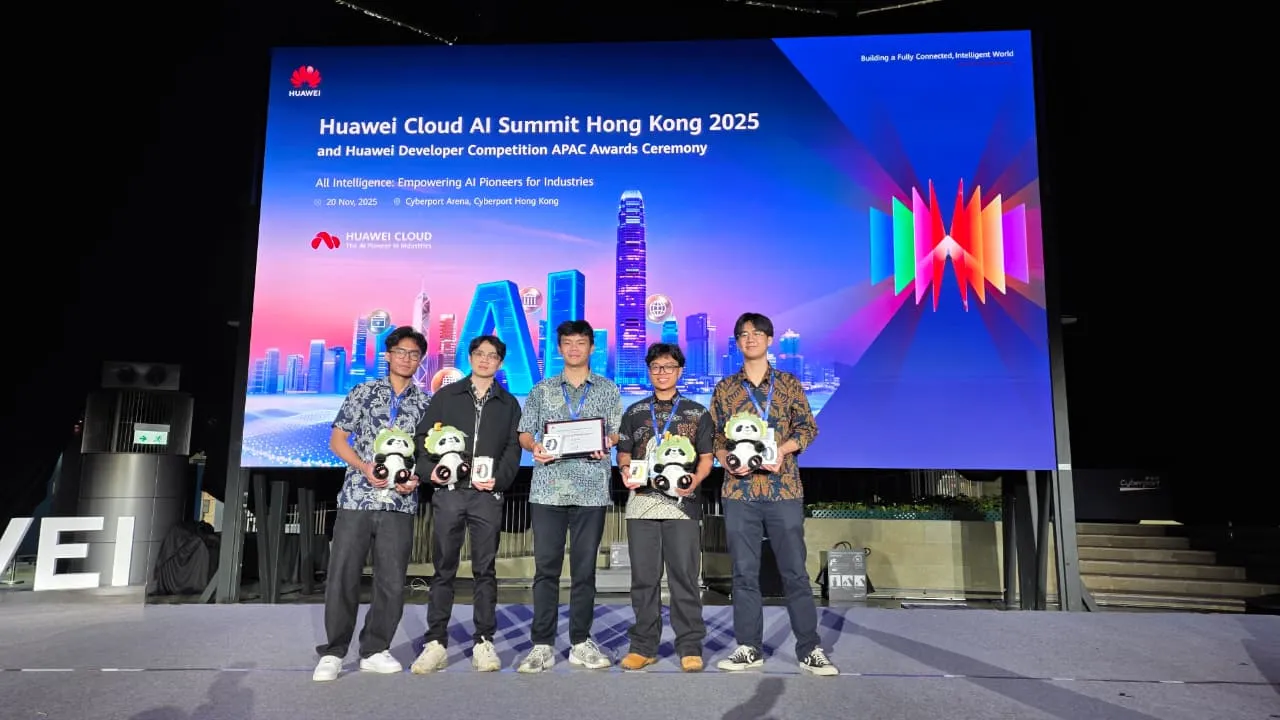
CitiFlowAI was built for the Huawei Developer Competition 2025 (Asia Pacific). We reached the APAC Grand Final in Hong Kong, pitching at PolyU as the only team representing Indonesia in our track.
The problem
CitiFlowAI is a Traffic Management as a Service (TMaaS) platform built on Huawei Cloud. We anchored it to a problem we live with: in the Greater Jakarta area, traffic congestion costs an estimated Rp 100 trillion (about $6.1 billion) a year in wasted fuel, lost productivity and health costs, and the average Jakarta driver loses 89 hours a year stuck in traffic. Building more roads can’t keep up, so the realistic fix is to make the existing roads work better.
Most “smart” traffic systems still only react: lights run on timers, or a central model looks at past trends and suggests changes for engineers to approve. CitiFlowAI tries to act before gridlock forms. Each intersection is an AI agent, and the agents work together to create “green wave” corridors and clear the way for emergency vehicles.
What I did
I led the team and owned the machine-learning work, including framing the problem as multi-agent RL, building the SUMO simulation and the ModelArts training pipeline, and coordinating the team into the APAC final. I also drove the pitch during the pitching event.
Building it
Fixed-cycle lights can’t react to live traffic, and a controller that only looks at one intersection often just pushes the jam to the next one. So I treated each intersection as an agent in a shared environment and trained them together with Multi-Agent Reinforcement Learning (MARL), so they learn to cooperate instead of each being greedy. The simulations ran in SUMO and training ran on Huawei ModelArts.
The system is split between the edge and the cloud, because speed matters most here. Sending camera video to the cloud and back takes 500–1000 ms, and by then an ambulance is already in the intersection. So:
- Edge: a Huawei Atlas 500 box at each intersection runs the trained policy on the live video and makes decisions in under 200 ms.
- Cloud: ModelArts collects anonymized data from every intersection, learns city-wide patterns, and trains the main MARL model that coordinates green waves along whole corridors.
Video is processed at the intersection and never stored; only anonymized data is sent to the cloud, where it feeds live dashboards and long-term reports.
The model also keeps improving. Every night ModelArts retrains on that day’s data, and the new model is rolled out to each Atlas box with a blue-green deployment: the new version starts next to the old one, gets checked, and then takes over, so there’s no downtime.
Outcome
In simulation, the MARL agents moved 6× more vehicles than a fixed-cycle baseline, and the edge-cloud setup ran about 73% faster than a cloud-only one, which is what makes real-time green waves and emergency priority possible.
We also made the business case. Sold as a subscription, TMaaS turns a large upfront infrastructure cost into a predictable monthly one, which makes it easier for cities with tight budgets to adopt. We closed the pitch with the live demo.
It is unfortunate that we were unable to make it to the podium, other teams such as the startup teams already had real-world implementations and better business models, while others had real use-cases. I feel that’s where we fall short, as we were still students without any real implementation or use-case, and the product we showcased was still ultimately a simulation.
What I learned
This event has given me a big wake-up call, especially in handling a team and performing in a competition. I feel that I still had so much to learn, and this experience has taught me a lot. Even so, I am truly grateful to be able to be in the grand finalist position in my first ever competition.